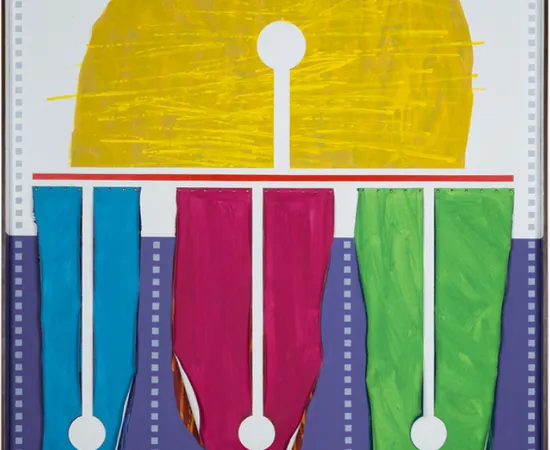
Jan Kotík (1916–2002) was one of the key figures of modern Czech art, known for his intellectually grounded and conceptually oriented approach to painting and visual thinking. As the son of Pravoslav Kotík, he grew up in an artistic environment that shaped his early development and lifelong engagement with art. Kotík was not only a painter and draftsman, but also a theorist and translator with a deep interest in philosophy and literature. This broad intellectual background strongly influenced his work, in which he combined visual experimentation with conceptual reflection.
After early involvement with Skupina 42, he gradually moved toward abstraction and became an important contributor to postwar informel. From the late 1950s onward, his work developed a distinctive “scriptural” character and increasingly explored the autonomy of the image through structure, variation, and spatial relationships.
In the 1960s, Kotík began to anticipate key aspects of conceptual art, for example in his reduced paper collages and experimental approaches to form and space. After moving to West Berlin in 1969, he further developed these ideas in an international context, engaging with contemporary tendencies related to the ZERO movement and European conceptual practices.
Kotík’s work is defined by a continuous search for new possibilities of painting beyond traditional boundaries—often balancing intellectual rigor with a strong sense of visual form. Today, he is regarded as an important link between Czech modernism and international conceptual art.